

Industrial Categories
see the categories and sub-categories
- Automation Network
- Calibration Services
- Health & Safety
- Logistics
- Machinery Safety
- Monitors
- Measurement & Control
- - Chlorine
- - Compressed Air Consumption
- - Compressed Air Dew Point
- - Compressed Air-Medical Quality
- - Compressed Air Oil Content
- - Conductivity
- - Dissolved Oxygen
- - Dust
- - Flow - Liquids
- - Flow - Gases
- - Flow - Solids
- - Gases - Flammable
- - Gases - Toxic
- - Humidity
- - Level - Continuous
- - Moisture of Bulk Solids
- - PH
- - Power
- - Pressure
- - Speed
- - Temperature
- - Velocity-Air
- - Vibrations
- - Weight
- Panel Meters
- Sensors
- Thermal Imaging
- Wireless Communication
Conductivity
Conductivity is an expression of the ability of a solution to conduct electric current. It is expressed as a microsiemen (micro-Siemens per centimeter or µS/cm) or in higher conductivity levels as a millsiemen . 1000 µS/cm are equal to 1 mS/cm. Some industries such as water treatment have adopted a measurement expressed as TDS (Total Dissolved Solids). TDS is approximated with conductivity using a multiple factor and is expressed in parts per million (ppm).
Conductivity is measured with two surfaces in contact with the sample. These surfaces can be constructed of graphite, stainless steel, platinum and other similar materials. An AC voltage waveform is sent through one contact of the sensor (Sending) and passes through the liquid being measured. The second contact surface (Receiver) receives the signal. The resulting measurement determines the conductivity of the water and is displayed on a conductivity instrument which expresses the measurement as microsiemens, millisiems or total dissolved solids (ppm).
Another sensing method uses an inductive 2-coil system encapsulated in a plastic case to send and receive the signal from the instrument. This inductive system, known as a toroidal conductivity sensor, can eliminate polarizing effects that may affect the measurements of a contacting conductivity probe.
Why is Conductivity/ TDS Measurement Necessary?
From controlling biocide and scaling in cooling towers and boilers to the water you drink, conductivity plays a part in a multitude of applications across many industries.
Common Applications:
- Monitoring reverse osmosis (RO)
- Chemical concentration monitoring
- Cooling tower & boiler protection
- Environmental monitoring
- Industrial effluent monitoring
- Control of activated sludge process
- Profiling conductive dissolved solids content in water
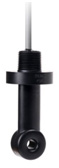
Our S3020 Toroidal Conductivity Sensor (Inductive Conductivity Sensor) delivers the most reliable technology for monitoring conductivity and total dissolved solids (TDS). Unlike contacting conductivity sensors, the 3020 is resistant to fouling, coating, and corrosion, and is designed for minimal maintenance and long service life. Built for harsh applications, the durable Noryl construction is tolerant to a wide range of solvents, and the sensor remains stable to temperatures up to 105° C.
- Superior measurement technology provides accurate, stable measurements
- Resistant to coating, fouling, and corrosion for accurate, reliable measurements
- Wide measurement range
- One year limited warranty

- Reliable process monitoring: Displays conductivity & process temperature values simultaneously
- Simple system integration: Loop-powered (16-35V DC) with isolated 4-20mA output signal
- Perfect for use in all environments: LCD display with NEMA 4X, IP65 enclosure
- For use with toroidal conductivity sensors: Online conductivity measurement with minimal maintenance
- One year limited warranty
Our 8300 In-line Heavy-Duty Process Contacting Conductivity Sensor delivers accurate, reliable monitoring of conductivity and total dissolved solids (TDS). Sensor maintenance is simple with detachable S855 Cable Assembly. Sensor package is built with automatic temperature compensation (ATC) with options for integration to any conductivity transmitter or controller. Ideally suited for conductivity measurement applications from ultra-pure water to cooling water.
Reliable performance: Built-in automatic temperature compensation (ATC) for accurate measurements over a wide temperature range
Minimal sensor maintenance: Flat graphite measurement surface design resists coating and fouling even in harsh applications
Fast, simple installation: Integrate the sensor into your system in seconds with no tools required
One year limited warranty
Temperature Compensation: 1000Ω RTD
Cable length: 3 meter
Connectors: Tinned Leads/Tinned

Dual display shows the measuring value and temperature
Compatible with a wide variety of contacting conductivity, resistivity, and TDS sensors
One year limited warranty

NOTE: Transmitter is only compatible with sensors with tinned leads and Pt1000 RTD temperature compensation.