

Portable Categories
see the categories and sub-categories
- Air Velocity
- Chlorine
- Coating Thickness
- Compressed Air
- - Consumption-Losses
- - Dew Point
- - Leak Detection
- - Medical Air
- - Particle counter
- - Purity
- - Oil monitor
- Concrete Thickness Meter
- Conductivity
- Crane Scales
- Dissolved Oxygen
- Endoscope
- Flue Gas Analysis
- Flue Gas Leakage
- Flow
- Gas Detection
- HACCP
- Humidity
- Light Intensity
- Multi-Function
- Particles
- PH
- Pressure
- Pyranometer
- Reinforcement Bar Locator
- Sound
- Speed/Rotation
- Temperature
- Thickness
- Turbidity
- Vibrations
- Water Leak Detectors
- Wind Speed
Compressed Air Leak Detection

Compressed air leak detection equipment plays a crucial role in preventing downtime and improving the overall efficiency and cost-effectiveness of industrial operations. Here's how it helps:
Minimizes Energy Waste: Compressed air systems are often one of the largest consumers of energy in industrial settings. Air leaks can result in a significant loss of compressed air, leading to higher energy consumption and costs. Leak detection equipment helps identify and locate these leaks quickly, allowing for prompt repairs and preventing wastage of energy.
Prevents Equipment Damage: Air leaks can lead to pressure drops in the system, which can negatively impact the performance of pneumatic equipment. Consistent pressure is essential for proper operation. Detecting and fixing leaks promptly can prevent wear and tear on equipment, extending its lifespan and reducing the likelihood of costly breakdowns.
Maintains Productivity: When compressed air systems are inefficient due to leaks, it can result in reduced productivity and increased downtime. By using leak detection equipment to identify and repair leaks proactively, you can maintain consistent and reliable operation, minimizing interruptions to production processes.
Reduces Maintenance Costs: Frequent air leaks can lead to increased maintenance and repair costs for the compressed air system. Identifying and fixing leaks before they become severe can save on maintenance expenses and extend the life of the equipment.
Enhances Safety: Compressed air leaks can create safety hazards in the workplace, including noise pollution and the risk of flying debris. Leak detection equipment can help in identifying and addressing these hazards, thereby enhancing workplace safety.
Environmental Benefits: Reduced air leaks mean lower energy consumption, which can lead to a reduced carbon footprint and a more environmentally friendly operation.
Improved Cost Efficiency: By preventing energy wastage and reducing maintenance and repair costs, compressed air leak detection equipment helps in optimizing the cost efficiency of industrial operations.
Sigma 530 Handheld Ultrasonic leak detector for compressed air & Pneumatic systems
The Ultrasonic leak detector Sigma 530 allows maintenance personnel to detect a leak on the spot by being able to distinguish the leak sound among various equipment sounds. By integrating this technology into your maintenance routine, you can effectively prevent downtime, save on energy costs, and improve the overall reliability of your compressed air systems.
When gases are leaking through tubes and tanks an ultrasonic sound is produced which can be detected by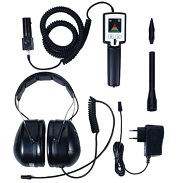
The ability to discriminate between these sounds is accomplished by an electronic process called `heterodyning` that accurately converts the inaudible ultrasounds sensed by the instrument into the audible range where users can hear the audible signal through supplied noise isolated headset.
It is therefore simple to isolate these signals from any background plant noises and to detect their exact location.
The high frequency, short wave, directional characteristic of ultrasound enables users to accurately pinpoint the location of a leak or a particular sound in a machine.
The basic advantages of ultrasonic instruments are that they can easily locate leaks, provide advanced warning of impending mechanical failure and can be used in loud, noisy environments.
In unpressurized systems an ultrasonic tone generator can be used whose sound will leak through small openings. Sigma 530 integrates a laser pointer which helps to spot the leak from distance.
Optional Accessories
Ultrasonic Tone Generator
The optional ultrasonic tone generator can be a useful addition to the standard kit for  detection of leaks from unpressurised pipes, vessels, enclosures, and tightness tests. This allows for testing of welds, joints and seals without the cost or contamination issues of actual gas testing. The ultrasonic tone generator can also be useful as a training tool for new users.
Applications also include leak detection for,
Any gas leaks in general
Tanks
Pneumatic brakes
Pipe systems
Oxygen plugs in hospitals
Pressure and vacuum systems
Steam traps
Valves
Refrigerants
Partial electrical discharges causing damages on insulations
Insulation tests on doors and windows
Tightness tests
Acoustic Imaging Detector
Sigma532
Sigma532 is a specific industrial device—an advanced acoustic imaging detector designed mainly for finding leaks and electrical faults using sound.
Specifically the Sigma532 Acoustic Imaging Detector is a portable, “sound camera” -like instrument made for industrial maintenance. It detects sound (including ultrasound) and converts it into a visual image showing exactly where a problem is. 
Key features
64 MEMS microphones → captures sound very precisely
Frequency range: 0–96 kHz (includes ultrasonic sounds)
Detection distance: up to ~100–150 meters
Real-time acoustic imaging → overlays sound hot spots on a camera image
Built-in camera & touchscreen (around 4.3″ display)
Data storage & recording (images, video, voice notes)
What it’s used for
The Sigma532 is mainly used in industrial environments to detect:
1. Air & gas leaksSigma532
Compressed air systems
Vacuum systems
Gas pipelines
Even very small leaks can be detected visually
2. Electrical faults
Partial discharges (like corona discharge) in high-voltage systems
Early detection helps prevent equipment failure
3. General maintenance
Mechanical noise issues
Preventive inspections in factories
How it works
The microphone array in the device captures sound from many angles
Using techniques like beam forming, it calculates where the sound originates
The result appears as a colored “sound map” over a real camera image
Why industries use it
Detects problems from a distance (safe and fast)
Finds invisible leaks that waste energy
Reduces maintenance time and costs
Helps improve efficiency and safety